
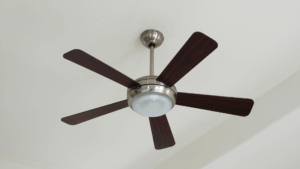
 Did you know the direction your ceiling fan spins can actually affect how warm or cool your space feels? Changing your fan’s rotation is an easy way to improve temperature control and save energy in your home or small business. In this blog, we’ll share everything you need to know about which direction your ceiling fan should spin each season and why it matters.
Which Way Should a Fan Spin in Summer?
In the summer, your ceiling fan should spin left, or counterclockwise, when you’re looking up at it.
When your fan spins counterclockwise, it pushes cool air downward. Though it doesn’t actually lower the temperature in your room, it can still help you feel several degrees cooler thanks to the wind-chill effect.
If you take this effect into account, you can raise your thermostat a few degrees and still feel comfortable with the breeze, saving energy (and money!) in the high summer temperatures. In fact, raising your thermostat 7-10 degrees Fahrenheit can decrease energy usage by up to 10%.
Ideally, you should use a high-speed setting in the summer to maximize airflow and keep air moving throughout the room. Plus, putting less strain on your air conditioner reduces wear over time, so you can keep it in good condition longer.
Which Way Should a Fan Spin in Winter?
In the winter, your fan should do the opposite of what it does in the summer, meaning it should spin clockwise at a low speed.
Spinning your fan this way pulls cooler air up and pushes warm air back down along your walls from where it has risen. As a result, you get a gentle circulation that distributes warmth evenly throughout the room. Just remember to keep it at a low speed so you don’t create a noticeable breeze.
By adjusting your fan this way, you can lower your thermostat by 1-2 degrees while still staying warm in the winter months, potentially resulting in up to 1-3% energy savings per degree.
How to Change Your Fan’s Direction
Switching your ceiling fan’s direction is simple, yet it’s something many homeowners and small business owners don’t know how to do. Generally, here’s how you go about it:
- Turn the fan off and let it come to a complete stop.
- Find the direction switch, which is a small toggle usually found on the fan’s motor housing.
- Flip the switch to change the direction.
- Turn the fan back on and make sure the blades are spinning the right way.
If your fan uses a remote control, check the manual for instructions on how to use the remote to switch the spin direction. Some modern fans will allow you to do this directly from the remote or a wall control panel.
Even a quick check and flip twice per year can make a big difference in how your space feels and how efficiently your heating and cooling systems run. These benefits pair perfectly with protection from Agway EnergyGuard®, our repair program that covers eligible heating, cooling, and electrical systems*, so you have peace of mind when your systems need repair.
Saving on Energy Use & Energy-Related Repairs
Your ceiling fan’s spin direction may seem like no big deal, but it’s one of the simplest and most effective ways to stay comfortable and use less energy year-round. Counterclockwise in summer keeps you cool, while clockwise in winter keeps you nice and warm.
At Agway Energy Services®, we provide reliable gas and electricity supply for homes and small businesses. Our Agway EnergyGuard® program offers added protection on eligible heating, cooling, and electrical systems* that suffer damage from wear and tear. Insurance coverage doesn’t protect you from this type of damage, but we do, because comfort shouldn’t come with the worry of unexpected repair bills.
Sign up today to protect your home or small business with EnergyGuard!
FAQ’s
When is the best month of the winter or summer season to make the fan direction switch?
Ideally, you should switch fan directions as soon as you start using your heat or air conditioning regularly. Depending on your location and climate, that’s May and October (possibly November), the start of summer and winter weather for most people.
Does fan speed matter in summer vs winter?
Yes, fan speed does matter in both summer and winter. In the summer, you should set your fan to high speed to create a cool breeze, while in the winter, you should set it to low speed to avoid wind chill.
Does difference in fan direction matter for vaulted or high ceilings?
Yes, the difference in your fan direction matters, even if you have vaulted or high ceilings. Warm air rises and can easily get trapped in high ceilings, so using the correct spin direction is especially important for distributing warm air in winter.
*Coverage depends on commodity purchased.
IMAGE:


