
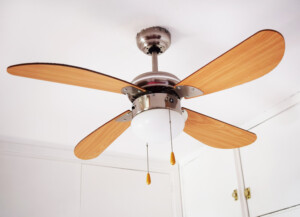
 Ceiling fans are one of the most energy-efficient ways to stay comfortable in your home year-round. Whether you’re staying cool in the summer or improving airflow in the winter, ceiling fans use far less electricity than most cooling systems.
Below, we’ll break down how much electricity a ceiling fan uses, what it costs to run, and how you can use one efficiently.
How Much Electricity Does a Ceiling Fan Use?
The amount of electricity your ceiling fan uses depends on factors like your fan’s size, motor efficiency, and speed setting. Most residential ceiling fans use between 15 and 90 watts, which is significantly lower than window air conditioning systems (500-1,500 watts).
Small Fans (<36 inches)
- Low speed: 10-20 watts
- Medium speed: 20-35 watts
- High speed: 35-50 watts
Medium Fans (42-48 inches)
- Low speed: 15-30 watts
- Medium speed: 30-50 watts
- High speed: 50-75 watts
Large Fans (52+ inches)
- Low speed: 20-40 watts
- Medium speed: 40-70 watts
- High speed: 70-90 watts
How to Calculate Your Ceiling Fan’s Energy Cost
Let’s take a look at how much it would cost to run a medium ceiling fan at high speed for 8 hours per day using the following formula:
Watts / 1,000 x hours used x kWh rate = cost
For this example, we’ll pretend we’re in Pennsylvania, where electricity is approximately $0.20 per kWh.
If a medium ceiling fan uses approximately 60 watts at high speed, the total cost to run it for 8 hours would be:
60 watts / 1,000 x 8 hours x $0.20 = ~$0.10
What Affects How Much Energy a Ceiling Fan Uses?
Several factors influence how much electricity you use when you run your ceiling fan:
- Fan size: Larger fans circulate air more efficiently, but they use more watts.
- Speed setting: Higher speeds use more energy.
- Hours of use: The longer you run your fan, the more energy it consumes.
- Motor efficiency: Newer fans with more efficient motors tend to use less power.
- Blade design and pitch: Well-designed blades circulate air more effectively, improving energy efficiency.
Even with these factors, ceiling fans remain one of the lowest-cost electrical devices in most homes.
Are Ceiling Fans Cheaper to Run Than Air Conditioning?
Yes, ceiling fans are significantly cheaper to run than air conditioning systems. While a ceiling fan typically only costs a few dollars per month to use, they don’t significantly lower your room temperature. Instead, they make you feel colder using a wind-chill effect.
Because of this, ceiling fans work best as a supplement to air conditioning, rather than a replacement during extreme heat. In places like New York and Pennsylvania, where summers are humid, combining fans with AC can improve comfort while reducing strain on your cooling system.
How to Use Ceiling Fans to Lower Your Energy Bill
Using your ceiling fan strategically can reduce your overall energy usage.
- Run fans only when in the room: Your fan cools people, not spaces, so turn them off when you leave the room to avoid unnecessary energy usage.
- Adjust fan direction seasonally: In summer, run your fan counterclockwise to create a cooling breeze. In winter, switch the direction to counterclockwise to push warm air downward.
- Keep blades clean: Dust buildup can reduce efficiency and airflow, so keep your blades clean year-round.
- Choose the right fan size: Using the appropriate fan size for your space ensures optimal air circulation without wasting energy.
How Your Electricity Rate Affects What You Pay to Run a Ceiling Fan
Your electricity rate plays a key role in how much you pay to operate any appliance, including ceiling fans. Electricity rates vary by state, utility provider, and market conditions.
In states like New York and Pennsylvania, electricity rates may fluctuate over time. Though ceiling fans use relatively little electricity, understanding your rate can help you estimate monthly costs effectively.
Keep Your Energy Costs Simple With Agway
Working with an energy supplier that offers clear, consistent pricing can make it easier to plan for seasonal energy usage, including using ceiling fans.
With reliable energy supply for home and small businesses in New York and Pennsylvania, Agway Energy Services® makes managing your energy usage simpler throughout the year. If you have questions about your electricity supply, billing, or available plans, reach out to our team today.


